Files stay files.
PDFs, documents, SVGs, images, archives, audio, video and links live next to the diagram. The preview helps you find your way; the original stays available to Windows.
Shot 1 / 2
Importing a file into the working context01 / 02
A visual space where any element opens the next canvas, and diagrams, files and context stay connected — level after level.
Not just a board. A space that grows with your thinking.
Instead of sprawling endlessly sideways — movement inward. Any object can become the entrance to the next level of detail without losing its link to the whole.
A double click leads into the child canvas.
Right now: “API Gateway” is selected — its child canvas can be opened.
One click selects an element. A double click opens its child canvas.
The tools do not compete for attention. They hold meaning, material and action in one space.
PDFs, documents, SVGs, images, archives, audio, video and links live next to the diagram. The preview helps you find your way; the original stays available to Windows.
Build process, UML and architecture diagrams on a real canvas: shapes, groups, labels and links stay part of the project.
The core work needs no server, no account and no constant internet connection.
Global search shows the path, opens the right canvas and takes you back to an object deep inside the project.
The native package keeps the whole project. External formats help you hand over, present or continue the material in another tool.
Import adds material to the current context. Export hands over the current canvas, a branch or the entire project in the format you choose.
Action history, safe deletion, a recycle bin, library checks and backup recovery protect the working context.
We compare centres of gravity, not logos. Miro bets on collaboration, draw.io on open diagram files, and Schemas on a local project where depth, files and the path stay part of one system.
| Criterion | Schemasthis product | Miro | draw.io |
|---|---|---|---|
| The problem the product is built around: what it does best and what it is willing to give up. | One whole local project | A collaborative whiteboard | An open diagram and file |
| How the tool organises content once one plane is no longer enough. | A child canvas belongs to one specific element: it has its own contents, its own camera and a way back to the parent. | Named regions of the board: they group content and set the frame boundaries for a presentation. | Flat pages inside a single diagram file; moving between them is built with links. |
| What happens to a PDF, an image or a document you put next to the diagram. | A file the project keeps in its own local library: the app builds a preview, and the original stays available to Windows. | Attachments on a cloud board | A file next to the diagram |
| Whether you can open and continue a project with no internet and no mandatory account. | Yes, locally | No official mode | Yes, in Desktop |
| The honest limit of each tool — what you should go to another product for. | Several people editing one project at the same time, with live cursors and comments. | Depends on cloud access | Less of a single project context |
You do not have to export a cloud board first to own a copy. The library, settings, history and material are stored locally and open like an ordinary Windows application.
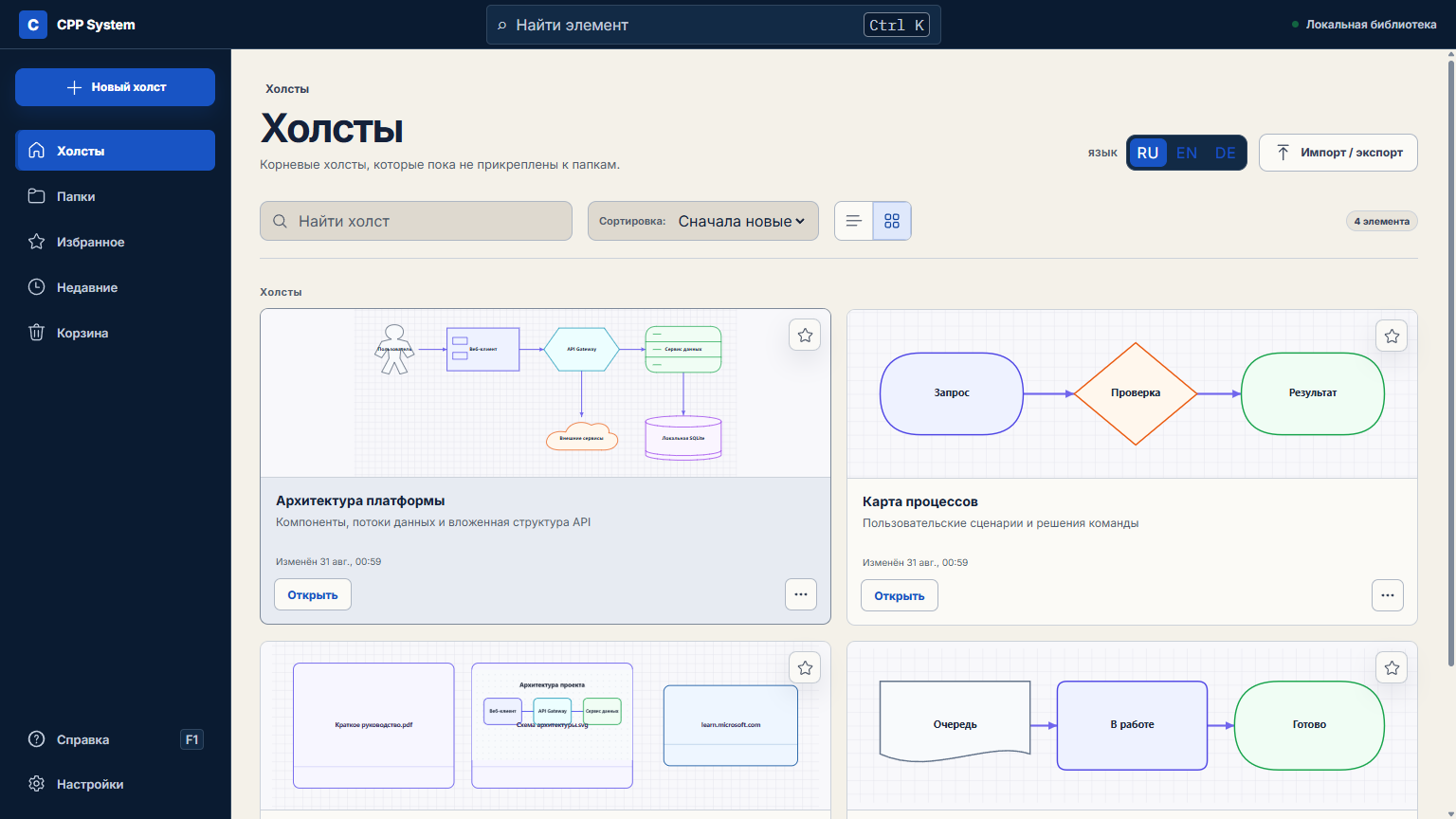 Local library · 01
The nearest tasks from the open plan. Each has a deadline, subtasks and a description of what will change in the work — any of them can be opened.
Первая публичная версия 1.0.0.0: сертификация Microsoft и установка в одно нажатие из Store.
Связь тянется от точки на стороне объекта к другому объекту — без переключения в режим связи.
Интерфейс, подсказки, сообщения и выгружаемые документы — на украинском.
Описание и материалы превращаются в дерево холстов. Готовое дерево помощник проверяет на дыры.
Новая доска начинается не с пустоты: заготовка приносит готовое дерево уровней, которое остаётся заполнить.
Give an idea room to grow — and a structure that keeps hold of the thread.
Explore the mechanics